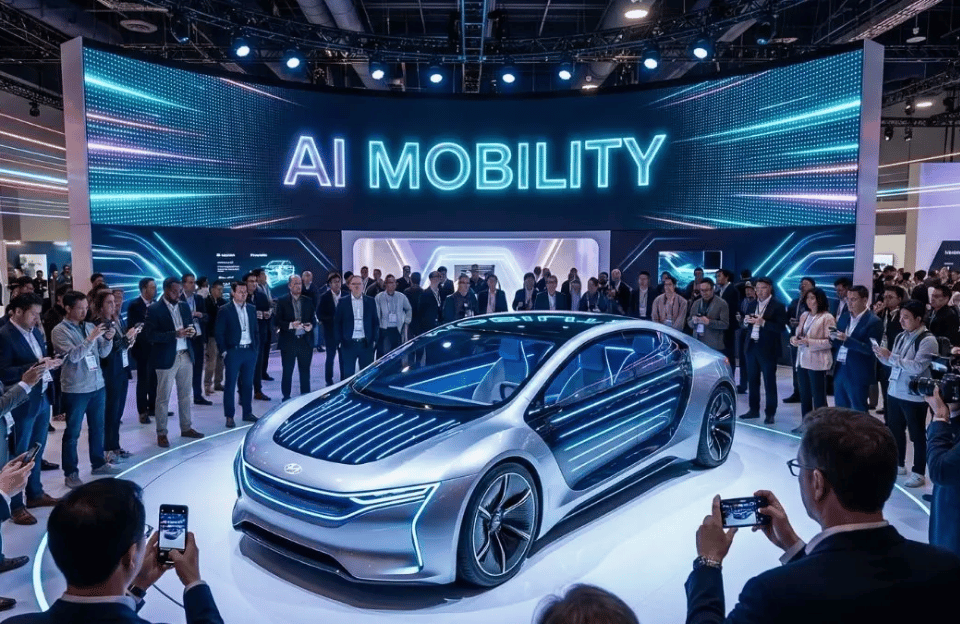
For years, autonomous vehicles (AVs) symbolized a distant future. At CES 2026 in Las Vegas, that future felt decisively present. The narrative shifted from \”emerging tech\” to an industry shifting into high gear.
Established players like Waymo and Zoox showcased their expanding city deployments and ambitious 2026 growth plans. Their futuristic vehicle displays drew massive crowds. But the show floor revealed a much broader competitive landscape taking shape.
Key partnerships and products are setting the pace. Uber, Nuro, and Lucid Motors unveiled the Lucid Gravity robotaxi, targeting passenger service by year\’s end. Tensor presented a personally-owned self-driving car also slated for a 2026 release. Nvidia’s keynote introduced Alpamayo, an open-source suite of AI models designed to give AVs more human-like reasoning for complex situations.
The scope of autonomy is expanding beyond passenger cars. CES highlighted its growing role in public transit, with collaborations like May Mobility and Tecnobus developing a 30-passenger autonomous minibus. Holon (a Benteler Mobility subsidiary) is partnering with Lyft to launch self-driving shuttles via the app, starting at airports this year. Industrial applications are also scaling, from Caterpillar\’s autonomous construction gear to Kodiak and Bosch\’s push in autonomous truck manufacturing.
\”The prominence of AVs at CES 2026—spanning robotaxis, personal cars, public transport, and industrial vehicles—underscores the sector\’s boom and the profound transformation underway in how we move,\” said Paul Miller, Forrester Principal Analyst on Mobility. \”CES mixes the mainstream, the ready-to-scale, and the experimental. Autonomous mobility now offers all of those.\”
A Glimpse on the Ground in Vegas
Beyond the convention center, the autonomous future was already operating. Zoox\’s distinctive robotaxis navigated the Las Vegas Strip. Waymo commenced local testing just before the show. In a striking moment, a ride in the Vegas Loop tunnel system unexpectedly placed me in a Tesla utilizing its Full Self-Driving technology—a direct hint at the anticipated Tesla Robotaxi.
The Roadmap for Expansion
While Las Vegas offered a concentrated view, broader rollout plans are active. Waymo (Alphabet) aims to expand its robotaxi service to over a dozen new cities in 2026. Zoox (Amazon) is poised to open to all public riders in San Francisco soon. The Uber-Lucid-Nuro partnership will launch in the San Francisco Bay Area late this year before targeting more locations.
The Paramount Challenge: Scaling Safely
\”Deployment is just the beginning,\” notes AV safety expert Phil Koopman. The next major hurdle is scaling safely, preventing failures, and maintaining public trust. The industry is acutely aware of high-profile stumbles, such as the suspension of GM\’s Cruise service following a severe incident. While Waymo has avoided that level of crisis, it has faced scrutiny over vehicles struggling in construction zones or during outages.
\”At scale, rare events become regular occurrences that must be managed for safe, reliable operations,\” Koopman emphasized. With public wariness high, the stakes for safety are immense.
\”Regulators and the public are currently far less forgiving of accidents involving autonomy than those involving human drivers,\” Miller added. \”A serious robotaxi accident could potentially destroy a company, a risk not typically faced by traditional taxi firms.\”
Navigating Business Model Realities
Some proposed business models remain unproven. Tesla and Tensor envision private owners offsetting costs by sending their AVs out as robotaxis (Tensor is partnering with Lyft for this).
\”It\’s unclear how this works in practice, or how willing people would be to let strangers use their expensive AV unsupervised,\” Miller commented. \”Fleet operators financing and maintaining vehicles seem a more plausible model for most cases.\”
The Road Ahead
If CES 2026 is any indicator, we will see a growing variety of autonomous cars, vans, and buses, especially as sensors and software improve and become more affordable. In parallel, advanced driver-assistance systems will become more widespread as stepping stones.
Intense competition lies ahead, and not all players will survive. Companies must contend with high costs, diverse operational environments, and complex regulatory hurdles.
\”I expect most will fail, being acquired or superseded by the few that successfully combine safe operations, viable technology, and a sustainable business model,\” Miller predicts.
Everywhere you looked at CES 2026, the transportation of tomorrow was on display—and increasingly, it\’s the transportation of today.