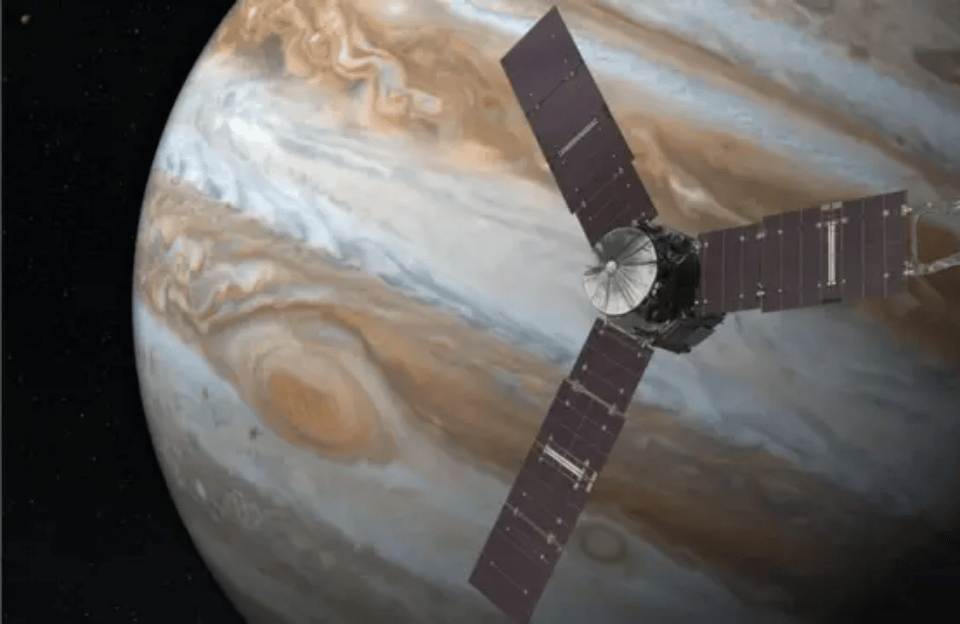
For centuries, Jupiter was a brilliant but featureless pearl in the telescope eyepiece. Today, thanks to intrepid robotic explorers, we have an album of this gas giant\’s portraits so detailed they reveal its turbulent soul. NASA\’s fleet of spacecraft has captured Jupiter from every vantage point—from heart-stoppingly close flybys to sweeping vistas billions of miles away—each image deepening our understanding of the solar system\’s largest planet.
The Intimate Portrait: Juno’s Revelations
Since 2016, NASA\’s Juno spacecraft has been rewriting the textbook on Jupiter. In extreme close-up, its JunoCam instrument has delivered images that feel more like abstract art than planetary science. Flying mere thousands of kilometers above the cloud tops, Juno reveals a world of breathtaking complexity.
Its photos show chaotic, textured cloud formations in shades of cream, crimson, and indigo. They expose clusters of massive, rotating storms at the poles—arranged in startlingly geometric patterns unlike anything seen in our solar system. Most importantly, Juno’s perspective is not just aesthetic; it is scientific. By peering deep beneath the obscuring cloud layers with its microwave radiometer, Juno has discovered that Jupiter’s iconic bands extend hundreds of miles down into the interior and that its core is likely fuzzy and diluted.
\”Juno gives us the view from inside the weather,\” said a mission scientist. \”We\’re not just looking at the surface of Jupiter; we are beginning to see the engine of its atmosphere.\”
The Classic Portrait: Cassini’s Grand Vista
In contrast to Juno’s intimate dive, the Cassini spacecraft provided one of the most iconic long-distance portraits of the Jovian system. In 2000, on its way to Saturn, Cassini turned its cameras back toward Jupiter, capturing a majestic, full-disk view.
This perspective, from about 10 million miles away, is the Jupiter we recognize: a majestic marble with parallel bands of tan, orange, and white, the Great Red Spot prominently anchored in the southern hemisphere. Cassini’s unique contribution was its ability to capture Jupiter in context—often with its four largest Galilean moons, Io, Europa, Ganymede, and Callisto, lined up like jewels on a string. Its images revealed global-scale waves and detailed atmospheric dynamics over time, a crucial \”big picture\” complement to close-up studies.
The Artistic & Scientific Portrait: Voyager’s Legacy and Hubble’s Watch
No discussion of Jupiter imagery is complete without the pioneers. The twin Voyager probes, in 1979, provided the first jaw-dropping close-ups, revealing the planet’s active weather, intricate ring system, and volcanic moons. Their legacy of discovery set the stage for all future missions.
Meanwhile, the Hubble Space Telescope, orbiting Earth, acts as a continuous remote observer. It provides annual weather reports, tracking changes in the Great Red Spot—which has been shrinking for decades—monitoring global storm outbreaks, and observing the impacts of comets and asteroids, like the famous Shoemaker-Levy 9 in 1994.
Why Multiple Perspectives Matter
These complementary views—near and far—are not redundant; they are essential. The distant view provides context, stability, and long-term monitoring. The close-up view reveals the mechanisms, the fine-scale physics, and the hidden depths. Together, they allow scientists to connect the large-scale behavior of Jupiter’s atmosphere with the small-scale turbulence that drives it.
As NASA\’s Europa Clipper mission prepares to launch toward Jupiter\’s icy moon, it will add yet another perspective to our growing gallery. Each new image, whether a detailed map of Europa\’s icy shell or another swirling storm on Jupiter itself, builds upon this legacy of seeing the king of planets from every possible angle, a testament to our relentless curiosity to understand our cosmic neighborhood.