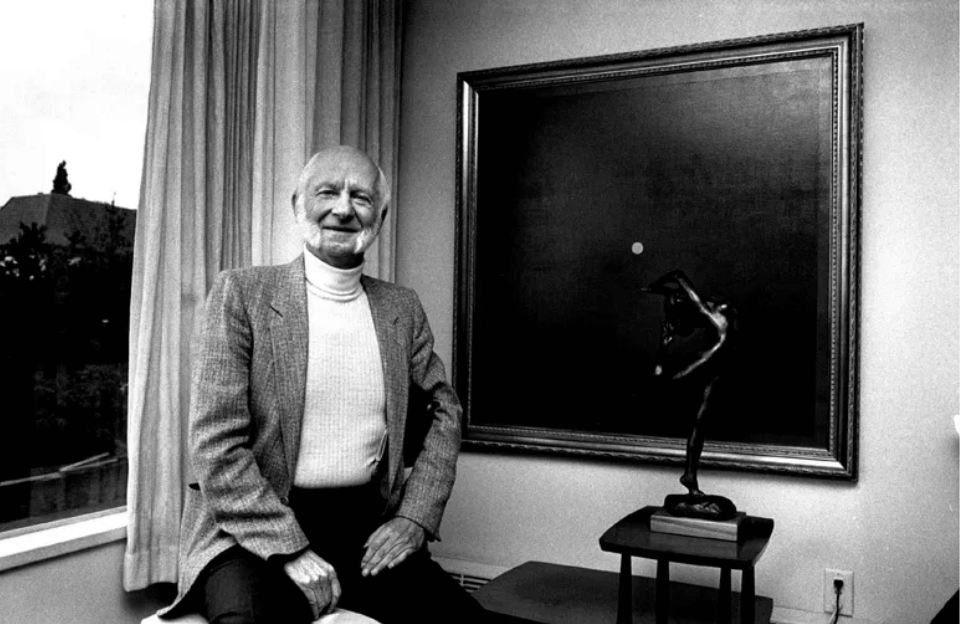
Hans Georg Dehmelt, a physicist whose elegant experiments captured and held individual particles, allowing humanity to study the electron with unprecedented precision and earning him a share of the 1989 Nobel Prize in Physics, died on March 7 at his home in Seattle. He was 94.
His death was confirmed by the University of Washington, where he had been a professor for decades. Dehmelt’s pioneering work moved physics from observing the behavior of vast particle crowds to conducting intimate “conversations” with a single, isolated entity—a foundational leap for modern quantum science and precision measurement.
The Art of Trapping the Invisible
Dehmelt’s Nobel-winning achievement centered on his development of the Penning trap, a clever device that uses a combination of electric and magnetic fields to suspend a single electron in a near-perfect vacuum, isolating it from the material world. For decades, the electron was understood only as a constituent of atoms, its properties inferred indirectly.
In the 1970s, Dehmelt and his team performed what seemed like a magic trick: they trapped a single electron, nicknamed it “Felix” after the cartoon cat whose nine lives suggested persistence, and studied it for months on end. This allowed them to measure the electron’s intrinsic properties, like its magnetic moment (its \”spin\”), with staggering accuracy—to within one part in a trillion.
“To isolate and study a single fundamental particle was a dream of physicists,” said David P. DeMille, a professor of physics at the University of Chicago. “Hans Dehmelt turned that dream into a practical, breathtakingly precise laboratory technique. He gave us a new window into the quantum world.”
A Journey Forged in War
Dehmelt’s path to scientific eminence was arduous. Born in Görlitz, Germany, in 1922, he was drafted into the German army during World War II and was captured during the Battle of the Bulge. As a prisoner of war in France, he taught himself physics using textbooks sent by an American soldier. After the war, he earned his doctorate at the University of Göttingen before immigrating to the United States in 1952, joining the University of Washington faculty in 1955.
It was there, in his Seattle lab, that his most famous work took shape. He shared the 1989 Nobel with Wolfgang Paul of Germany, who developed a different particle trap, and Norman F. Ramsey of Harvard, honored for work on atomic clocks. Dehmelt’s portion of the prize specifically celebrated his “development of the ion trap technique” and the measurement of the electron.
A Legacy of Precision
The implications of Dehmelt’s work extend far beyond a single particle. The techniques he pioneered for isolating and measuring electrons became the direct ancestors of those used in today’s most advanced atomic clocks, which define the second, and in quantum computing, where scientists must control individual ions or electrons as quantum bits (qubits).
He was also instrumental in the discovery of the anomalon, a short-lived subatomic particle, and in making the first precise measurements of the magnetic properties of the positron, the electron’s antimatter counterpart.
Colleagues remembered him not only for his brilliance but for his gentle, philosophical demeanor and his love for the beauty of experimental physics. “He thought of the trapped electron as a ‘little universe,’ a perfect system to probe the laws of nature,” said a former student.
Hans Dehmelt is survived by his wife, Diana Dundore, and a son from a previous marriage. His work survives in every laboratory where a single atom is held still, measured, and asked to reveal the universe’s deepest secrets—a lasting testament to the scientist who first taught us how to hold a particle of light and matter in the palm of a magnetic field.