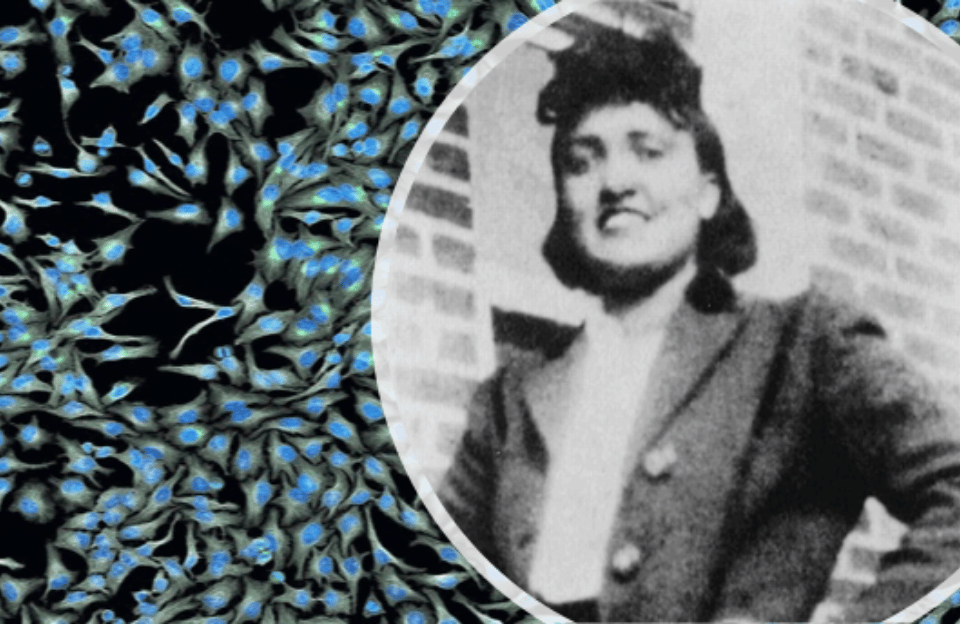
On October 4, 1951, a 31-year-old Black mother of five named Henrietta Lacks died from an aggressive cervical cancer at Johns Hopkins Hospital in Baltimore. In her final months, during diagnostic and treatment procedures, a doctor took a small, unconsented sample of her tumor. Those cells, unlike any human cells before them, did something extraordinary: they kept living. Thriving, in fact. They doubled every 20-24 hours in a laboratory dish, indefatigably, becoming the first immortalized human cell line in history.
HeLa cells, named from the first two letters of her first and last names, became one of the most consequential tools in modern medicine. They were aboard the first space missions to test the effects of zero gravity on human tissue. They were used to develop the polio vaccine, chemotherapy drugs, HIV treatments, and the HPV vaccine that might have saved her own life. They underpinned breakthroughs in cloning, gene mapping, and in vitro fertilization. To date, over 70,000 scientific studies and 11,000 patents have involved HeLa cells, generating billions of dollars in revenue for the biomedical industry.
For decades, Henrietta Lacks herself was known only as “HeLa,” an anonymized line of code in the scientific ledger. Her family, living with little means and no health insurance, had no knowledge that her cellular legacy was revolutionizing science until the 1970s. Their mother, wife, and sister was, in a very real biological sense, traveling the world, while they had never left their community.
The story of Henrietta Lacks, masterfully chronicled by Rebecca Skloot, is often framed as a parable about consent and racial injustice in medicine—which it undeniably is. But at its core, it presents a more fundamental and enduring question that now echoes in the era of CRISPR, biometric data, and commercial biobanks: When science needs your body to advance, what do you owe, and what do you own?
The Immortal Legacy: A Scientific Marvel Built on an Ethical Vacuum
The science of the 1950s operated in a different ethical landscape. There was no concept of “informed consent” for tissue research. It was common practice for doctors to use leftover surgical or diagnostic samples for research without a patient’s explicit permission. This was especially prevalent in public charity hospitals like Johns Hopkins, which served a large Black population.
George Gey, the researcher who cultured Lacks’s cells, was not a sinister figure by the standards of his day; he was a dedicated scientist who freely distributed HeLa cells to any researcher who asked, hoping they would accelerate medical progress. He never profited financially from them. The ethical breach was systemic: the reduction of a human being—her life, her lineage, her autonomy—to a purely instrumental biological resource.
The consequences of this breach were profound:
-
The Family’s Trauma: The Lacks family experienced deep psychological harm upon discovering Henrietta’s “immortality.” They heard her name on the news, saw her cells discussed in textbooks, yet were never consulted. They feared she had been cloned or was still suffering somewhere. They also lived with the cruel irony of being unable to afford the healthcare their mother’s cells helped create.
-
The Racial Imprint: The story cannot be divorced from the long history of medical exploitation of Black Americans, from the Tuskegee syphilis study to the case of the enslaved woman Anarcha Westcott, subject of experimental gynecological surgery. HeLa exists within this continuum, where Black bodies were often treated as readily available material for white medical advancement.
-
The Legal Void: The Lacks family’s attempts to gain control or compensation ran into a legal wall. In the 1990 case Moore v. Regents of the University of California, the California Supreme Court ruled that once tissue is removed from your body, you no longer retain property rights to it. Your cells can be patented and commercialized without your knowledge or share. The law protected intellectual property, not bodily integrity.
The Modern Landscape: Your Cells Are the New Gold Rush
If the HeLa story was a 20th-century problem, one might think it was solved. It has not been; it has been exponentially scaled. We are all potential Henrietta Lacks now, living in a world where our biological data is the most valuable resource.
-
Biobanks: Millions of us have voluntarily donated blood or tissue to massive repositories like the UK Biobank or the All of Us Research Program. These are built with modern consent forms, but the future uses of that DNA are often unknowable. Can you consent to a technology that hasn’t been invented yet?
-
Commercial DNA Kits: When you spit in a vial for a ancestry report, you are also, in the fine print, often granting a perpetual, royalty-free license for your genetic data to be used in research and potentially shared with pharmaceutical partners. Your unique genomic sequence becomes part of a dataset used to develop drugs you may one day buy.
-
Discarded Tissue: The “leftover sample” practice continues. A biopsy for a mole, a routine blood test, a removed appendix—these tissues can be anonymized and used for research. While identifiers are removed, your genetic essence remains.
-
Digital Biometrics: Your face, your gait, your heartbeat pattern—unique biological data captured by devices and cameras—are being aggregated and traded. This is the cell line data of the digital age.
The modern twist is that we often willingly participate, lured by the promise of health insights, ancestry stories, or simply the convenience of a genetic matchmaking service. The transaction feels benign, but the shadow of HeLa asks: Do we truly understand what we are giving away?
Reclaiming Agency: From Passive Donors to Informed Partners
The true lesson of Henrietta Lacks is not that we should withhold our cells from science. The medical miracles derived from HeLa are a testament to the immense good that human tissues can generate. The lesson is that science must shift from an extractive model to a partnership model.
This requires rebuilding the system on three pillars:
-
Dynamic, Informed Consent: Moving beyond dense, one-time legal documents to ongoing, understandable communication. Digital platforms could allow donors to update their preferences, choose to opt-in or out of specific new research areas (e.g., “mental health studies” vs. “commercial drug development”), and receive plain-language updates on how their donation is being used. Consent should be a living conversation, not a historical signature.
-
Recognition and Reciprocity: This doesn’t necessarily mean direct payment, which could coerce the vulnerable. It means a spectrum of reciprocity. For communities, it could mean a guaranteed share of any patents or profits funding local health initiatives or scholarships. For individuals, it could mean guaranteed access to therapies developed from the research, transparent results of the studies they enabled, or even a simple, dignified acknowledgment of their contribution—knowing their name, not just their code.
-
Community Governance: For large-scale biobanks, especially those involving indigenous or historically exploited populations, oversight should include community representatives. They can help design research priorities, ensure cultural sensitivity, and act as guardians against exploitation. This shares power and rebuilds the trust that was broken in cases like HeLa.
HeLa’s Final Chapter: A Shift in the Moral Compass
In a powerful act of moral correction, the story of Henrietta Lacks is arriving at a new kind of legacy. In 2021, the Lacks family reached a historic, private settlement with the biotechnology company Thermo Fisher Scientific over its commercial use of HeLa cells. While details are confidential, the act of settlement itself is symbolic: a multi-billion dollar entity finally acknowledging a debt.
More importantly, the World Health Organization (WHO) awarded its first-ever posthumous award to Henrietta Lacks in 2021, with her 87-year-old son accepting it. WHO Director-General Dr. Tedros Adhanom Ghebreyesus stated the new imperative clearly: “In honoring Henrietta Lacks, WHO acknowledges the importance of reckoning with past scientific injustices, and advancing racial equity in health and science.”
The National Institutes of Health (NIH) also now requires researchers using the full HeLa genome sequence to apply for access through a committee that includes two members of the Lacks family, giving them a long-denied voice in the stewardship of her genetic legacy.
Conclusion: You Are Not Just a Sample
Henrietta Lacks was more than a host for a virulent cancer. She was a woman who loved to dance, who put red polish on her toenails, whose children adored her. The great failure of science was to see only the cancer and not the person.
As we stand at the frontier of personalized medicine, where your unique cells could hold the key to your own cure or that of millions, we must carry this lesson forward. Science does need your cells. It needs your microbiome, your DNA, your data. But it needs them on terms that honor your humanity, your autonomy, and your legacy.
The call to action is dual:
-
For the public: Be a curious, empowered donor. Ask what will be done with your tissue. Read the fine print. Demand transparency and participate in shaping ethical research.
-
For science: Build systems that are not just legally compliant but are morally robust. Design consent for dignity. Share not just data, but benefits. See in every sample a person, a story, and a partner in progress.
The immortal cells of Henrietta Lacks taught us how to live forever in the lab. Our shared ethical task now is to ensure that the respect and dignity she was denied in life becomes immortalized in the very practice of science itself. In doing so, we honor not just her, but every person who offers a piece of themselves in the hope of a healthier future for all.