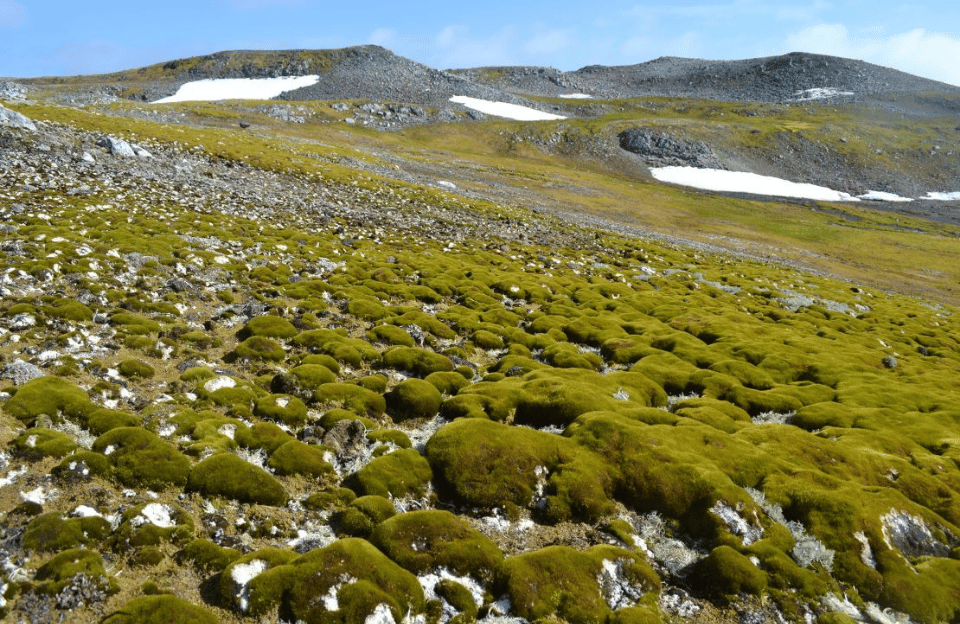
In the heart of Earth’s coldest, driest desert—Antarctica—scientists have uncovered a surprising chronicle of life thriving far away in the world’s forests and savannas. By analyzing ancient air trapped in ice cores, researchers have discovered compelling new evidence that global plant growth has significantly accelerated over the last century, with the rate of increase speeding up since the 1960s.
The key to this discovery lies in a carbon isotope known as carbon-14 (¹⁴C). Produced naturally in the upper atmosphere by cosmic rays, ¹⁴C mixes with ordinary carbon dioxide (CO₂) and is absorbed by plants during photosynthesis. However, the massive above-ground nuclear tests of the mid-20th century, primarily in the 1950s and 60s, created an enormous, time-specific pulse of artificial ¹⁴C—a \”bomb spike\”—that flooded the atmosphere.
This spike left a distinct signature in the tissues of every plant alive at the time. As scientists have now shown, it also left a precise record in Antarctic ice. By drilling deep into the ice sheets, teams from institutions like the British Antarctic Survey and the University of Washington have extracted pristine samples of ancient air bubbles. Using advanced spectrometry, they can measure the changing ratio of ¹⁴C to other carbon isotopes in atmospheric CO₂ over decades.
“The ice acts as a time capsule for the global atmosphere,” explains Dr. Sarah Green, a climate chemist involved in the research. “We can see the bomb spike arrive, peak, and then begin to decline. But the rate of the decline tells us a profound story about the Earth’s biosphere.”
The post-spike decline in atmospheric ¹⁴C happened faster than predicted by physical atmospheric models alone. The only plausible explanation for such rapid removal is a massive, global-scale uptake of carbon by plants—a process known as the \”terrestrial biosphere sink.\”
The Greening Engine: CO₂ Fertilization and Climate Change
The data indicates this acceleration in global photosynthesis, or \”greening,\” is primarily driven by two interconnected factors:
-
Carbon Dioxide Fertilization: Rising atmospheric CO₂ levels—a direct result of human fossil fuel emissions—act like a fertilizer for many plants. Higher CO₂ concentrations allow plants to photosynthesize more efficiently, using less water in the process, which can spur growth, particularly in forests and grasslands.
-
Climate Change Effects: Longer growing seasons in northern latitudes due to warmer temperatures, along with changes in precipitation patterns and nitrogen deposition from industrial activity, are providing more favorable conditions for plant growth in many regions.
“It’s a profound irony,” notes lead author Dr. James Robertson. “The same human activities that are causing potentially dangerous climate change through CO₂ emissions are also, in the short term, creating conditions that are supercharging plant growth across the planet. The biosphere is responding vigorously.”
A Complex Balance with Uncertain Future
While increased plant growth is absorbing a significant portion of human CO₂ emissions—currently mitigating the pace of global warming—scientists warn this is not a permanent or stable solution.
The greening trend is uneven. Some ecosystems may be reaching saturation points for CO₂ benefits, while others face increased stress from heatwaves, droughts, and fires. Furthermore, the enhanced growth does not necessarily translate to long-term carbon storage, as dying plants release CO₂ back into the atmosphere.
“The Antarctic ice has shown us the remarkable responsiveness of Earth’s plant life,” concludes Dr. Green. “But it also underscores the unprecedented scale of human impact on the planet’s fundamental cycles. This accelerated greening is a feedback within a system we are pushing hard. We cannot rely on it indefinitely to balance our emissions.”
The research, published in Nature, turns a signal of past nuclear activity into a vital tool for understanding the living planet’s real-time response to modern change, reminding us that even in Antarctica, the story of global life is written in the ice.