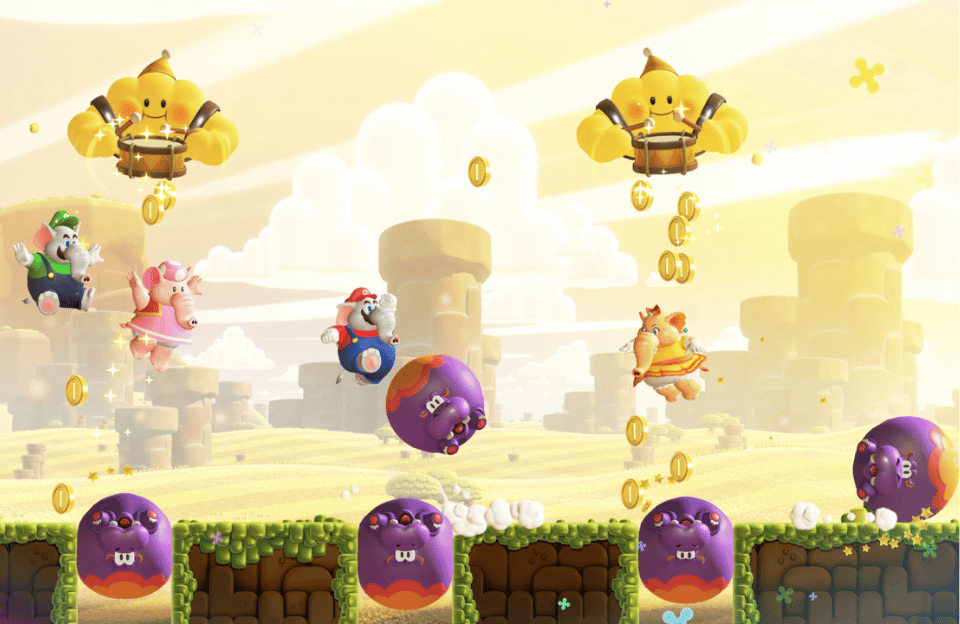
Nintendo has continued to leverage Switch 2 upgrades to fill out its release schedule, offering fans compelling reasons to revisit beloved titles from the original Switch. These enhancements typically focus on visual fidelity or add thoughtful extras—like the Zelda Notes feature introduced in Breath of the Wild and Tears of the Kingdom. However, the new upgrade for Super Mario Bros. Wonder, titled Meetup at Bellabel Park, takes a bolder approach. Pricier than some of its counterparts, this expansion transforms Mario Wonder into something nearly unrecognizable—a polished, full-fledged party experience, even if it may not be exactly what longtime fans anticipated.
Bellabel Park leans heavily into multiplayer, which is an intriguing pivot for a franchise renowned for its single-player platforming mastery. That said, single-player content hasn’t been entirely sidelined. The expansion introduces a new narrative thread centered around the eponymous park, home to rare Bellabel flowers. When the Koopalings steal them, Captain Toad and the Poplins step in to recover the stolen goods across the world map. Players will discover a new brigade tent in each world, leading to a showdown with one of the Koopalings.
For newcomers progressing through Mario Wonder for the first time, this adds a neat layer of discovery. Veterans, meanwhile, can jump straight into a series of creatively reimagined boss battles. Enhanced by the Wonder Flower, each Koopaling undergoes a fantastical transformation—Wendy becomes a bulbous Cheep-Cheep-like creature, while Morton is reworked as a massive marionette puppet. These encounters blend traversal challenges with inventive, stage-altering effects, breathing new life into classic villains that have had little to do in recent entries.
Beyond the boss fights, Bellabel Park includes a set of challenge stages framed as a Toad Brigade Training Camp. These are grouped by objective—such as collecting all coins under a time limit, defeating every enemy, or, in a standout example, navigating a course while maintaining invincibility through a steady supply of Super Stars. The challenges grow increasingly complex, introducing special conditions like traversing stages as a bouncy ball or equipping the Spring Feet badge for added difficulty.
Players also gain access to new tools. Rosalina joins the character roster, though she controls like other standard characters within Mario Wonder’s gameplay framework. A more substantial addition is the Flower Pot power-up, which grants every character a flutter jump (similar to Yoshi’s) and the ability to fire vertically moving flowers to target threats from above. It’s a clever new mechanic, brought to life with charming animations—including a skipping run cycle—though its use is largely confined to the Koopaling boss fights. Bringing the Flower Pot into older stages requires a roundabout process of carrying it or customizing badges to make it spawn, limiting its overall impact.
Where Bellabel Park makes its most lasting single-player contribution is through the introduction of Dual Badges. These combine the effects of existing badges into more powerful hybrids—for instance, merging the Parachute Cap with the Boosting Spin Jump allows for extra height and extended floating. The ! Blocks + Sensor badge combines both detection tools into one. These enhancements effectively outclass the original badges, making them difficult to leave behind.
Dual Badges are obtained through a gacha-style system by watering plants in the Bellabel Park hub. Water is earned by completing challenge stages and participating in multiplayer matches. Rewards include badges, emotes, decorative flowers, and even musical instruments that contribute to a Poplin band’s performance. While the challenge stages provide a steady source of water, the multiplayer component is where the hub truly shines, offering a more efficient and engaging way to accumulate resources through local or online play.
The multiplayer hub is structured like a classic Mario world map, with local multiplayer options on the left and online Game Room offerings on the right. Local games are split into versus and co-op categories, with each minigame lasting only a minute or two. The Attraction Tour feature at the front desk allows players to queue up a series of minigames, with filters for difficulty (Easy, Medium, Hard) and format (versus or co-op). While a playlist customization feature would be a welcome addition, the randomized rotation keeps gameplay fresh and accessible.
The sheer volume of minigames is impressive. Even a single attraction like Coin Rush offers multiple variants, each with four to six courses spanning different difficulty levels. Across the board, the number of unique games is staggering, ensuring a steady stream of new experiences for groups.
What sets Bellabel Park apart from traditional party-game offerings—including Mario Party—is its laser focus on core Mario platforming mechanics. Every minigame builds on the same fundamental skills, making the experience instantly approachable for newcomers while maintaining depth for seasoned players. This unified design philosophy creates a cohesive and intuitive party experience.
Within that framework, the minigames explore genuinely inventive concepts. A co-op Captain Toad-inspired challenge splits movement and jumping duties between two players. Another co-op game uses the Switch 2’s mouse functionality to let one player build Donut Block platforms while others navigate the stage. In Phanto Tag, players disguise themselves as objects while one opponent tries to expose them. One standout, Baby Yoshi’s Feeding Time, has players feeding apples and enemies to their Yoshi, with the leader gradually slowing down as their character grows more rotund. The variety is consistently surprising, and the competitive platforming action lends itself to the kind of close-call, shout-at-the-screen moments that define great multiplayer gaming.
Meetup at Bellabel Park may not be the single-player expansion some Mario Wonder fans expected, but it delivers a remarkably robust and inventive multiplayer experience—one that makes creative use of platforming fundamentals while standing confidently on its own.