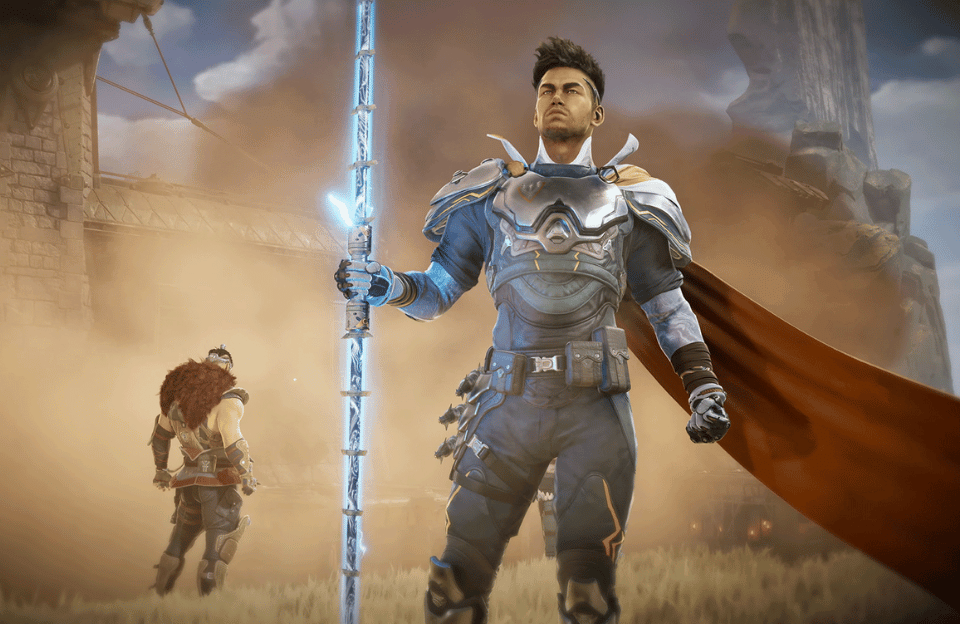
Crimson Desert is at its best when exploration and combat collide. In the lead-up to its release, much of the conversation has centered on whether the game could possibly deliver on the staggering ambition of its trailers—which have showcased everything from dragon-riding and mech-piloting to Shadow of the Colossus-style boss encounters. Developer Pearl Abyss has certainly aimed high with its first single-player title, and there is no denying that Crimson Desert is an extraordinarily ambitious game, stitched together with as many ideas as humanly possible.
On a broad scale, this approach works exceptionally well. While it doesn’t reinvent the open-world formula, its world is expansive, technologically impressive, and genuinely fascinating to explore—a tantalizing sandbox for the game’s weighty, visceral combat. It is on a smaller scale where cracks begin to show. Irritating design choices around inventory management and healing become persistent sources of friction, and quest design often fails to play to the game’s strengths. As a result, Crimson Desert is a game I wanted to love more than I did. I cannot overstate how remarkable its open world is, nor how much fun I had feeling like a medieval John Wick—but there are also areas where it could have been so much better.
An Open World That Rewards Curiosity
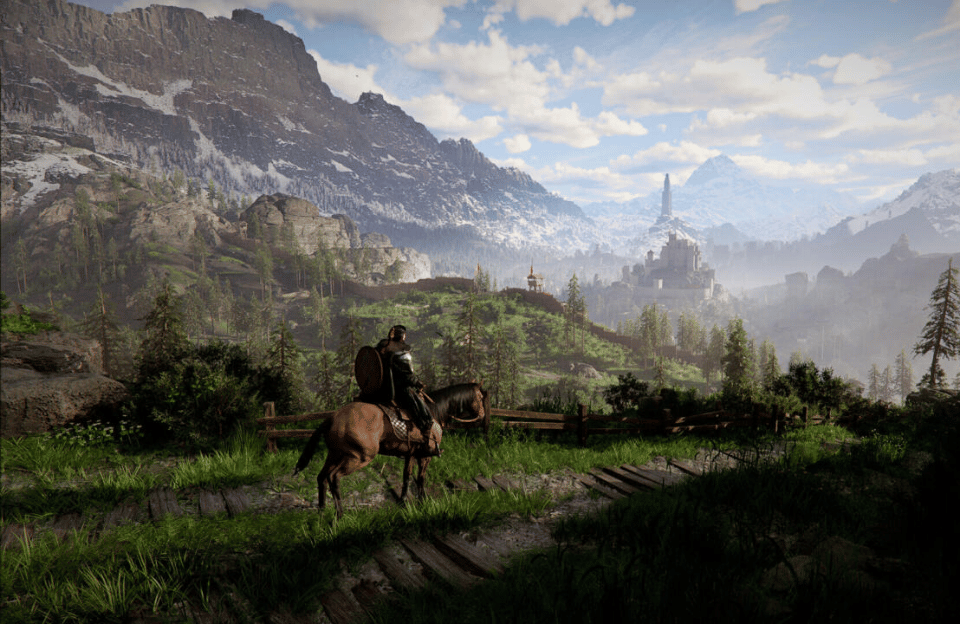
A few hours into my adventure, I decided to explore east of the Duchess of Hernand, the game’s starting location. Beyond a sloping valley, I spotted what looked like a giant diving board perched on a mountain ridge. With that landmark in my sights, I set out to scale the chalky cliff face and discover what this intriguing structure was.
After figuring out the climb—finding spots to rest and replenish stamina along the way—I reached the top. The wooden structure turned out to be a mysterious pulley, but the view instantly captured my attention. Pastoral countryside stretched to the horizon, dotted with hamlets, meadows, and dense forests. Snow-capped peaks reached for the clouds, and several hilltop castles stood within riding distance.
After taking in the scenery, I did what felt natural: I leaped. A feathered wingsuit slowed my descent, and below, I spotted a group of soldiers clad in black and red armor. Eager for a fight, I landed nearby and barreled into them, following a brutal clothesline with bloody swipes from my sword. Then the big guy appeared—a 10-foot-tall enemy who struck me with enough force to send my ragdolling body splintering a tree. No matter. I dusted myself off, ate some vegetable porridge to restore health, and used an ability called Nature’s Grasp to telekinetically lift the fallen tree trunk and whack my towering opponent upside the head.
This sense of organic discovery defines Crimson Desert. There were several times I simply picked a direction and explored for hours, purely for the sake of it. The map itself evokes a sense of adventure, with evocative location names—Mistveil Forest, The Crimson Wall, Mountain of Frozen Souls, Rattlesnake Steppe—urging you to seek them out.
On one expedition, I reached the edge of the map and found a cove filled with rocky spires, using my wingsuit to glide between them. Nearly any surface can be climbed, provided you have enough stamina to find solid ground before it runs out, turning traversal into a puzzle. After crossing the cove, I spotted airships in the distance and headed toward them, stumbling upon a castle where an ongoing battle raged between orcs and swarms of steampunk insects. Mechanized bees attacked from above while ground forces included deadly mantises and rhinoceros beetles, each standing over 20 feet tall.
This wasn’t my fight—at least not yet—so I ran, dodging ranged fire until I escaped into a stunning valley. There I found Tinkerton, an anomalous town with electric streetlights. Robots worked the fields, drones flew overhead, and a steam train passed on the outskirts. The sheer breadth of flora and fauna, the world’s impressive verticality, and the way your lantern illuminates pitch-black nights all contribute to an environment that feels alive.
Combat That Delivers Visceral Thrills
This freedom of expression extends to Crimson Desert‘s excellent combat. Kliff, the gruff mercenary protagonist, hits with a visceral ferocity that is immediately satisfying. As you master his versatile style, combat becomes increasingly fluid—chaining combos, thrusting his sword forward before leaping into a dropkick that ends with your downed opponent skewered on the blade.
Enemies swarm in large numbers and don’t wait their turn, forcing you to parry and dodge while repositioning for another barrage. You can leap into the air and return with an explosive slam, knocking over anyone nearby. A range of context-sensitive wrestling moves lets you suplex enemies into oblivion or surprise them with an RKO out of nowhere. You can heave foes off cliffs, pull them toward you with the grappling hook, and bash them with your shield. Even the skill tree prioritizes expanding your repertoire over flat stat improvements, consistently rewarding you with new ways to dispense punishment.
A Narrative That Struggles to Keep Pace
The story, however, is less compelling. Set on the vast continent of Pywel, you play primarily as Kliff, a no-nonsense mercenary. Early on, you and your Greymane brothers are ambushed by a rival outfit, the Black Bears. While most of your allies are scattered, you are clearly killed before being thrown into a raging river.
Up to this point, the dialogue fits a Game of Thrones mold—a range of British Isles accents and a liberal use of colorful language establishing a familiar high-fantasy tone. But the tone soon shifts. Kliff is resurrected by a mysterious, technologically advanced force. Within the first hour, you are transported to a floating sky fortress by an unassuming beggar, given the wingsuit and a futuristic grappling hook, and told that reality itself hangs in the balance. Kliff takes all of this in stride, adapting without question in a way that feels jarring.
Crimson Desert isn’t interested in a nuanced story. It is broadly painted in black and white, shifting between George R.R. Martin-style fantasy and sci-fi elements, with villainous monologues before, during, and after many boss fights. Rather than “show, don’t tell,” the narrative often opts for “don’t show or tell.” Events, locations, and characters are mentioned as though you should already know them, but the story makes little effort to provide context.
Instead, information is tucked away in the Knowledge tab of the pause menu, where brief entries offer details on characters and factions. This would be fine for supplementary world-building, but it shouldn’t be the only way to discover essential context. In one side quest, I faced Saigord, the Staglord, in a one-on-one battle. His monologue made no sense to me. After defeating him, I checked his Knowledge entry: “The king of a forgotten realm, erased from history as if he never existed. Though he has lost his people, his riches, and even his sanity, he remains shackled to the crushing weight of a duty he refuses to abandon.” That is information I would have liked to encounter naturally before fighting him, but the quest itself centered on finding missing soldiers, with Saigord appearing unceremoniously at the end.
This pattern recurs throughout both side and main quests. The main story often feels like moving from one objective to the next without meaningful connective tissue. I gave money to the beggar not because the game gave me a reason to, but because it appeared as my next objective. When I needed a new outfit to enter Hernand Castle, I headed to a house in need of a chimney sweep for no discernible reason. Crimson Desert frequently lacks narrative cohesion, leaving you to follow a quest log rather than immersing yourself in its world.
To its credit, the game does offer considerable quest variety—from large-scale battles and hunting a murderous crow-obsessed cult, to finding a lost sheep or toppling a merchant guild’s despotic leader. But the lack of narrative depth undermines what could have been memorable side stories, especially when the groundwork already exists in the Knowledge tab.
A Wealth of Activities, Hampered by Inventory Constraints
Outside of quests, there are plenty of distractions. You can hunt bounty targets, gamble in parlour games, compete in arm wrestling, hand-to-hand combat, archery duels, and rock-paper-scissors. You can race horses, trade based on market trends, invest in a bank, fish, cook, chop trees, mine ore, and much more. These activities add to Pywel’s appeal as a place worth inhabiting.
But you are frequently pulled away from exploration and combat to manage your inventory. You have only a few backpack slots, and while you can expand capacity through side quests and additional pockets, absolutely everything takes up space. Extra weapons and armor, crafting materials, tools, quest items that persist after completion, furniture for your home, cooking ingredients, cooked meals, books, wanted posters, notes, recipes, skill-unlock items, bugs, flowers—the list is exhaustive.
The core issue is the lack of storage access. You own both a camp and a house, but neither offers a place to stash items for later use. Upgrade materials are not especially common, yet I regularly had to sell or drop items I could have used to improve my gear simply to make room for new ones.
Cooking is particularly frustrating due to the number of ingredients each recipe requires. Early on, fitting them all into your inventory at once is difficult, even though food is the only way to heal. Eating raw ingredients provides negligible healing, so cooking proper meals becomes essential—but some ingredients are notably difficult to find, and the inventory system actively works against you.
The Verdict
Crimson Desert is a game of striking contrasts. Its open world is among the most impressive in recent memory—expansive, vertically rich, and filled with moments of genuine discovery. Its combat is brutal, fluid, and deeply satisfying, offering a level of freedom and expression that elevates every encounter. The sheer variety of activities and the sense of adventure baked into exploration are achievements in their own right.
But these strengths are held back by persistent friction. A narrative that lacks cohesion and fails to contextualize its most interesting characters diminishes the emotional stakes. A cumbersome inventory system with no storage solution undermines the flow of exploration and combat. And quest design often prioritizes objectives over immersion, leaving you feeling like you are checking boxes rather than living in the world.
Even so, Crimson Desert delivers on its core promise: a vast, breathtaking open world paired with combat that is as ferocious as it is flexible. If Pearl Abyss can address the quality-of-life friction points, there is an extraordinary experience here waiting to be fully realized. For now, it remains a deeply impressive but uneven debut—a game that soars in its heights and stumbles in its small but significant details.