This past week, Nvidia unveiled its latest graphics upscaling technology, DLSS 5, with a new feature that gave in-game character models AI-powered makeovers. Their drastically altered appearances—transformed into a style often associated with cheap mobile games—drew immediate public backlash. Critics objected not only to the aesthetic results but also to the fact that the technology altered work that developers had labored over, seemingly without their input.
The incident highlights a broader tension: gamers are rebelling against the use of generative AI in the games they play, particularly when its presence is not disclosed. This resistance creates a complex environment for implementing AI—whether it is used to assist in code and art creation during development or in player-facing applications such as generating non-player character dialogue in real time.
A Skeptical Industry
In January, the organizers of the Game Developers Conference released their annual State of the Games Industry report for 2026. Among respondents, 52% reported that generative AI was used at their company, though only 36% said they personally used it as part of their jobs. Some noted that its use remains optional, at least for now. The technology is primarily employed for research and brainstorming (81%), writing emails and scheduling (47%), and code assistance (47%), among other tasks.
However, developer skepticism is growing. Fifty-two percent of respondents said they believe generative AI is bad for the industry—a sharp increase from 30% the previous year.
By the time GDC took place in mid-March, uncertainty around generative AI permeated the event. As I walked the halls of the convention, I observed a stark juxtaposition: a handful of smaller games proudly showcasing generative AI features, and relative silence from the rest of the industry.
Early Days, Modest Adoption
It remains very early for generative AI in video games. At prior GDC events, I had seen prototype AI-powered NPCs running on Nvidia technology and demonstrations of how AI assistants could provide in-game tips. But neither of these player-facing applications has yet appeared in any major 2026 release, nor have they meaningfully debuted at the margins. If there were a killer generative AI application that made its use essential—either in production or in gameplay—it would likely be widely known.
As Chris Hays, lead services programmer at id Software, put it: generative AI is not nearly as transformative as the truly paradigm-shifting technologies we have witnessed before.
“People weren’t begging people to use the web when it came out. If [generative AI] was really as revolutionary as the web, people would be using it,” Hays said.
I sat down with Hays, who is also a lead organizer at id Software’s Big Friendly Union, and Sherveen Uduwana, treasurer at the United Videogame Workers union (which made its public debut at last year’s GDC 2025), to discuss the state of the games industry, including how much generative AI is currently being used by developers. Between the two, the consensus was: not much. In the cases where it is used in development, humans have had to step in and correct AI-generated errors.
“I’m skeptical, even for the studios that say, ‘We’re implementing AI into the process.’ We’re not seeing the number of revisions that are happening after these AI-generated content, where essentially a worker is going in and fixing all these mistakes to the point that it possibly could have been done without the AI in the first place,” Uduwana said.
Amusingly, Hays noted that freelancers he has spoken with have welcomed the AI push—they are being hired to fix AI’s mistakes.
Who Is Actually Using Gen AI?
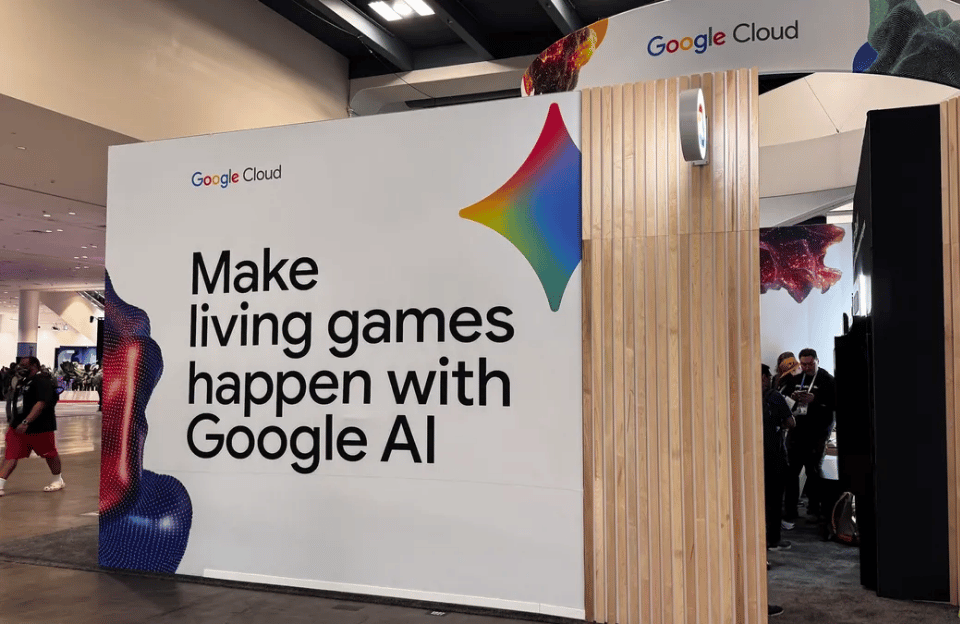
At one major tech company’s booth on the show floor, the company demonstrated how its generative AI assistant could be used in games—including some that were set to launch. The demos were rudimentary. One showed how players could talk their way through a village and order a drink at a tavern using AI-powered NPC conversations. Another involved walking around a server farm, shooting robots while an AI assistant maintained a constant flow of commentary, even healing the player if they took too much damage.
Alongside these demos were actual games reportedly coming soon. One, a mobile strategy game called Colony by Parallel Studios, is aiming for release within the next three months. The game lets players oversee and defend a settlement on a distant world. As game director Andrew Veen explained, Colony uses large language models in two ways. First, it allows players to solve in-game challenges with creative suggestions that the AI judges—for instance, to thaw a frozen power core, players have tried bombs, flamethrowers, napalm, and even pickaxes, all of which worked.
Second, Colony uses a workflow that generates 2D images of objects and then converts them into 3D models within the game. Currently, players can create helmets for their characters this way, with plans to expand into armor, furniture, and vehicles—a concept Veen described as Animal Crossing meets Fallout Shelter in a distant-future setting. Converting an image to a 3D item takes about two and a half minutes, and because Colony is an “idle” mobile game where progress happens in real time, that delay is built into the mechanics.
Veen added that the AI tools have also accelerated his studio’s development workflows, helping with coding and design feedback. The studio began work on Colony nearly a year ago and worked independently for the first eight months. Partnering with the tech company and using its AI tools enabled the team to accomplish more in the subsequent three months than in the eight without it.
“I don’t think we get here without [this technology],” Veen said.
Notably, beyond this single company’s presence, there were few other major players showcasing generative AI integrations—not even some of the industry’s largest tech firms, which had previously promoted AI initiatives. Despite a block of sponsored panels, the biggest news from one major publisher was about next-generation hardware development kits.
Panels and Perspectives
GDC’s primary draw is looking backward, with most programming consisting of panels where developers discuss lessons learned from the previous year. The highest-profile sessions covered major 2025 releases, while smaller discussions focused on disciplines such as audio, graphics, and narrative. The vast majority of AI-related panels were sponsored sessions, reinforcing that generative AI had not meaningfully appeared in last year’s games.
However, some illuminating panels featured developers from smaller studios experimenting with generative AI in their pipelines. In one, product development specialist Irena Pereira, founder of Unleashed Games, explained how generative AI can help overcome the “blank page problem”—generating hundreds of rough ideas from which a single promising concept can be developed into a proper quest, item, character, or story beat.
“[You’re] creating those compelling stories that really should be coming from you, but they can start in a more automated popcorn kind of zone that is brought to you by AI, and then at the end of the day, you finish it as a human,” Pereira said.
What became clear was the restraint: generative AI may be used in preproduction or organization, but not in anything that ends up in the final product.
That caution is likely wise given the sensitivity of gamers to anything AI-related. Late last year, Baldur’s Gate 3 creator Larian faced backlash after CEO Swen Vincke mentioned using generative AI in ideation for its next Divinity game. The studio subsequently confirmed it would abandon certain generative tools to ensure it could trace the provenance of art ending up in the final product. In the same public Q&A, Larian also acknowledged experimenting with other machine learning tools to “reduce the ‘mechanical legwork'” and speed up development.
This and similar incidents have fueled player backlash whenever AI use in game development surfaces. For developers, the issue is more nuanced. David “Rez” Graham, AI programmer and lead developer of The Sims 4, who hosts AI roundtables at GDC for developers to share ideas, explained that the industry is generally opposed to generated assets such as art ending up in games. However, engineers have begun experimenting with code assistance and generation tools.
The difference, Graham discussed in his GDC panel on the human cost of generative AI, lies in intent. Art generators like Midjourney are designed to replace artists, while most current code-generating tools are intended to assist and accelerate engineers’ work. These tools are ineffective unless the user already knows what they are doing. Graham had an AI tool audit a project of around 2,000 lines of code to look for bugs; of the 12 issues it reported, only two were actual problems. The other ten were false positives, and applying the suggested fixes would have introduced ten new bugs.
“You still need significant programmer oversight, so the tools act more like an accelerator,” Graham said. “As long as that remains true, I think engineering will continue to embrace them.”
Reading the Tea Leaves
In previous years, the convention halls were draped in advertisements for gaming companies riding waves of speculative technology—from blockchain to NFTs to web3. Now the focus is generative AI. Though the advertisements were less garish this year, it is difficult to shake the association with past trends.
Yet generative AI applications appear to have more genuine potential than those earlier technologies, even if they are not yet widespread. Unlike its predecessors, generative AI is being treated with caution.
One sponsored panel, hosted by an AI audio company, was titled “How to Build or Use Generative AI That Is Legally Compliant, Safe, and Ethically Sustainable.” The presenter carefully explained that the only ethical way to clone an actor’s voice to generate lines for a game is to properly license all data directly from them, be transparent about its use for generative AI, and share revenue.
Generative AI applications in gaming remain piecemeal. Behind closed doors, one major technology company demonstrated an AI-powered advisor intended to help players in a strategy game. While strategy titles typically offer generic advice, this advisor would make recommendations based on the player’s specific situation—answering questions about why a nearby province rebelled, for instance, while withholding information outside the player’s knowledge.
The Road Ahead
Whether in-game or in development, generative AI tools are not yet mainstream in gaming. We are beginning to see use cases at the edges of game development, but they are far from being embraced by the world’s largest game companies.
Despite years of hosting AI roundtables at GDC and working directly on AI applications in gaming, Graham is hesitant to make predictions. Things are moving too quickly, and the industry has not yet grappled with major issues: using stolen work for training data, environmental impact, economic consequences, and labor displacement. Considering the intense investment in the technology with little financial return, Graham likens this moment to the dot-com boom and bust. He expects a similar wave of AI company failures—and when the dust settles, the final form of AI in gaming may emerge. Perhaps by then, the US, the EU, and other countries will have established AI regulations.
In the short term, Graham expects more companies to try integrating generative AI into their experiences. He pointed to a game released last August that is extremely upfront about using AI to power dynamic conversations between the player and the main character—a game that holds a “Very Positive” rating on Steam.
“It’s clear that players aren’t against gen AI as a whole, just when it’s used in place of art,” Graham said.
For union leaders and developers Hays and Uduwana, the reasons generative AI remains confined to smaller games—and absent from major titles—are twofold: the tools are not yet refined enough, and developers are actively resisting technologies that threaten their fellow workers’ employment.
“I know anytime we even have any discussions about AI, it’s like, it should never do something that you couldn’t do yourself,” Hays said. “If it’s not an accelerant for you, then you’re not using a tool. You’re just having something that’s replacing someone’s job.”
Hays acknowledged that Microsoft, which owns his studio id Software, is a major backer of AI, but so far the company has stated it wants generative AI tools that accelerate work productivity—and his union is taking that at its word.
“We’re not against movement forward. We’re against things that are immoral, that take jobs, that are bad for the environment, that are bad for people,” Hays said. “And if there are wins, then it would be OK. But there haven’t been, which is why there’s not a lot of movement.”
Generative AI’s inability to rival what developers can create is a testament to their competence and skill, Uduwana added. The thousands of hours of labor that go into making games deliver an attention to detail that players notice, find compelling, and respond to emotionally.
That positive reception to conventionally made games is directly linked to players’ negative reactions when they discover undisclosed AI use in game creation. Sometimes the truth emerges when gamers recognize crudely generated assets or text. Even when the AI-generated materials are minimal or left in by accident, as with a game last year, players still feel betrayed and become mistrustful of other aspects of the game.
“I do think that people who play games are smart about what they’re consuming, and that they see the impact that generative AI has, and how it’s leading to less quality control in the franchises that they are really excited about,” Uduwana said. “And I think that those anxieties are things that there’s common ground between the workers and the people playing the game.”
To these seasoned developers, a simple truth remains: generative AI is not being used in big games yet for good reason.
“There are plenty of studios that are pushing AI. They’re not the ones that are doing well,” Hays said. “Everyone sees it, and the players are rejecting it. So long as we want to be successful, we’re not going to be using [AI] tools.”