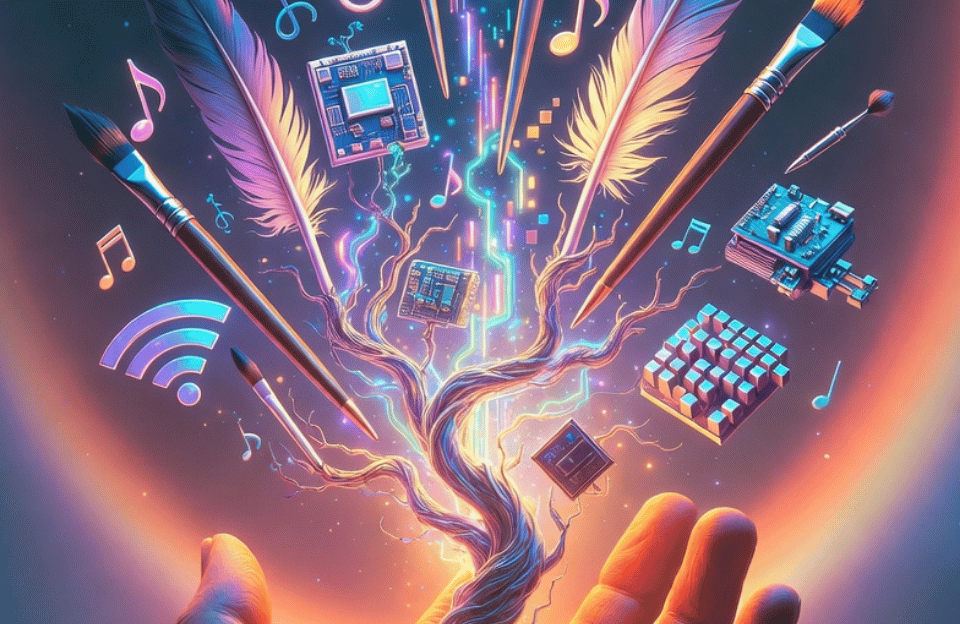
We have long romanticized creativity as a solitary spark—a lightning bolt of inspiration striking the lone genius in a garret, armed with nothing but a quill, a paintbrush, or a blank sheet of paper. This mythology is powerful, but it is obsolete. In the 21st century, the primary catalyst for an unprecedented explosion of human creative expression is not a muse, but a gadget.
From the smartphone in your pocket to the niche tools on a specialist’s desk, modern devices have transformed from passive instruments into active collaborators. They have democratized creation, collapsed disciplinary boundaries, and fundamentally altered the creative workflow itself. This is not about technology replacing human ingenuity; it is about technology augmenting and amplifying it, acting as a force multiplier for the imagination.
The Democratization of the Means of Creation
The most profound impact of gadgets on creativity is the sheer democratization of access. For millennia, high-fidelity creative tools were the domain of the privileged or the professionally apprenticed.
-
The Pocket Studio: A modern smartphone is arguably the most potent creative tool ever mass-produced. It contains a professional-grade 4K video camera, a multi-track digital audio workstation (DAW), a photo editing suite, a graphics design canvas, and a publishing portal to global audiences—all in a device smaller than a notebook. The barrier to filming a short film, composing an electronic symphony, designing a logo, or writing and distributing a novel has plummeted from thousands of dollars and years of training to the cost of a data plan and a willingness to learn.
-
From Consumer to “Prosumer”: Gadgets like affordable mirrorless cameras (Sony Alpha series, Fujifilm X-series), consumer drones (DJI), and desktop 3D printers (Creality, Prusa) have created the “prosumer” class. These are tools that offer near-professional capability at a fraction of the historical cost, enabling indie filmmakers, hobbyist engineers, and bedroom producers to create work that rivals studio output. The hit song can now be mixed in a teenager’s headphones; the viral short film can be shot and edited on a single device.
This shift has unleashed a tsunami of content and talent from corners of the world previously silent in the global creative conversation. It has diversified the narratives we hear and the art we see, challenging traditional gatekeepers.
The Collapse of Disciplinary Walls
Traditional creative domains were siloed. A painter worked with pigment and canvas; a musician with instruments and score paper; a writer with a typewriter. Modern gadgets, built on universal digital code, are inherently polymathic.
-
The Convergence Device: A tablet with a stylus, like an iPad Pro or a Microsoft Surface, is the ultimate polymath’s gadget. In one session, a creator can sketch a storyboard (visual art), record a voiceover (audio), animate the sequences (motion graphics), and score the piece (music)—all within a single, portable slab. Software like Procreate, GarageBand, and LumaFusion speak to each other, making the flow between mediums seamless.
-
Generative AI as a Co-Pilot: The latest wave of gadget-adjacent software—AI tools like ChatGPT, Midjourney, and Suno—acts as a radical creative accelerant. They are not replacing the creator but serving as an instant brainstorming partner, a tireless editor, or a visualizer of the unimaginable. A writer can break through writer’s block by dialoguing with an AI; a designer can generate hundreds of visual concepts in minutes to fuel their own refined vision. The gadget (or its cloud-based extension) becomes a collaborative engine, handling brute-force computation and pattern generation, freeing the human mind for higher-order tasks of curation, emotional resonance, and narrative meaning.
This fluidity encourages hybrid creativity. We now have musician-visual artists creating immersive audio-visual installations, programmers who are also poets crafting interactive digital literature, and architects using game engines to design virtual spaces. The gadget is the loom on which these once-separate threads are woven together.
The New Creative Workflow: Iteration, Not Inscription
The physical tools of the past favored a linear, permanent, and often daunting creative process. A mistake on a canvas or a manuscript was costly. The digital gadget, by contrast, fosters a non-linear, iterative, and fearless workflow.
-
The “Undo” Button as a Liberator: The single most psychologically liberating feature of the digital age is the “undo” command. It transforms creation from a high-stakes act of inscription into a low-risk process of playful exploration. “What if I try this radical color shift?” “What if I delete this entire chorus?” The ability to revert without consequence encourages experimentation, the lifeblood of creativity.
-
Layering and Non-Destructive Editing: Software allows creators to work in layers—be it in image editing (Photoshop), music production (Ableton Live), or video editing (DaVinci Resolve). Each element exists independently, can be adjusted, rearranged, or toggled on and off. This modular approach allows for infinite recombination and fine-tuning, making the creative process more akin to orchestrating adaptable components than carving immutable stone.
The gadget-enabled workflow is divergent, encouraging the generation of countless possibilities, followed by a phase of convergent editing and refinement. This mirrors modern design thinking methodologies and is fundamentally more aligned with how the exploratory human mind actually works.
The Networked Canvas and Instant Feedback
Finally, the gadget is almost invariably a networked device. This connectivity transforms the creative act from a private performance into a potentially public, collaborative dialogue.
-
Global Collaboration: A musician in Berlin can record a track, upload it to a cloud project, and a guitarist in Tokyo can add a layer hours later. Tools like Google Docs, Figma, and Splice turn creation into a real-time, multiplayer experience, dissolving geographical barriers.
-
The Feedback Loop Accelerated: Publishing a creation—a podcast, a digital painting, a video essay—can yield real-time feedback from a global audience. This immediate connection to the consumer of the work creates a dynamic feedback loop that can inform and shape subsequent iterations. The creative process becomes more agile and responsive.
The Caveats: The Glut and the Glare
This gadget-driven paradise is not without its shadows. The very ease of creation has led to a content glut, making discoverability a fierce new challenge. The constant connectivity can fracture attention, making the deep, sustained focus required for profound work more difficult to achieve—a phenomenon aptly termed “the glare of the gadget.”
Furthermore, the democratization argument hits a hard wall of algorithmic curation. Our creative outlets (social media platforms, streaming services) are governed by opaque algorithms that reward certain forms of creativity (short, viral, engagement-driven) over others. The gadget gives us the voice, but the platform can dictate the dialect.
Conclusion: The Symbiotic Spark
The narrative is no longer about the lone genius and the blank page. It is about the connected creator and the enabled canvas. The modern gadget is that canvas, studio, instrument, library, publishing house, and collaborative network all in one.
It drives human creativity not by providing the idea, but by removing the friction between the idea and its execution. It acts as an infinite sketchpad, a mistake-forgiving partner, a disciplinary polyglot, and a bridge to the world. In doing so, it has expanded the very definition of who can be a creator and what creation can be. The spark of genius remains human, but the gadget is the bellows, the lens, and the amplifier that allows that spark to ignite a global blaze of innovation and expression. Our creative future is not human or machine; it is a symbiotic loop, powered by a chip, guided by a soul.