While preschool cartoons often fade with trends, Bluey has cemented its status as a streaming phenomenon, captivating adults and children alike with its sharp writing, emotional depth, and celebration of imaginative play. It was only a matter of time before this success inspired video game adaptations. Bluey: Quest for the Gold Pen from Halfbrick Studios is the latest attempt, offering a well-crafted but intentionally simple adventure that serves as a gentle introduction to gaming for the very young.
This title stands in direct contrast to the earlier Bluey: The Video Game. Where that release focused on free-play minigames in the Heeler household but felt lacking in direction, Quest for the Gold Pen provides a more structured, goal-oriented experience. It trades pure domestic sandbox play for a familiar adventure framework, making it feel more like a \”proper\” video game—albeit one paced deliberately for little hands.
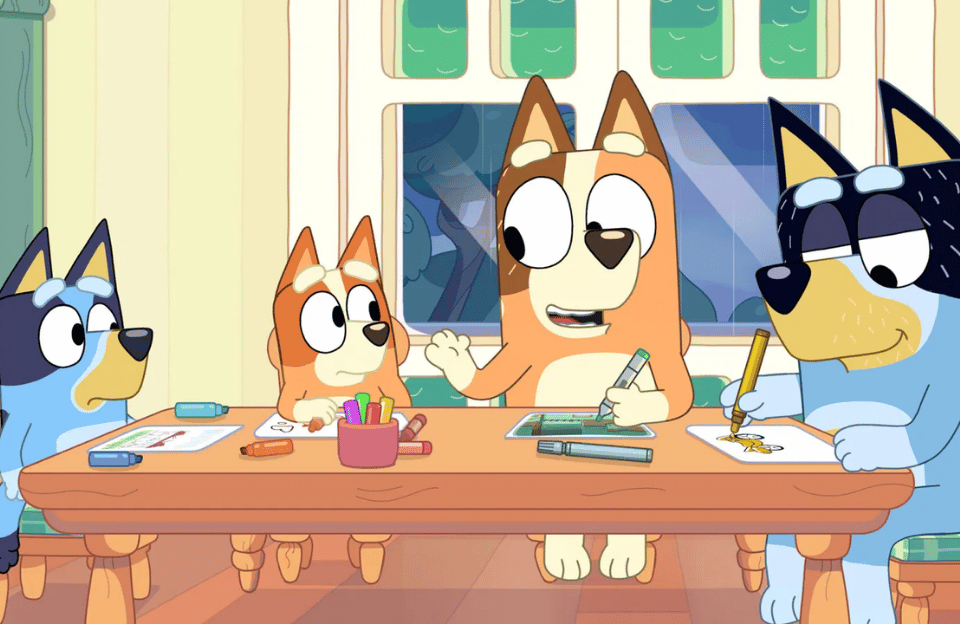
The premise is pure Bluey: a rainy day indoors leads to drawing, which spirals into a playful conflict. Dad Bandit Heeler, in his role as gentle antagonist, confiscates the coveted golden pen, setting the kids on a quest to retrieve it. Faithful to the show\’s spirit, Bandit\’s mischief is a catalyst for creativity, a nuance reinforced by charming animated cutscenes.
The game\’s visual triumph is how it translates the family\’s artistic styles into its world. Drawing inspiration from the beloved \”Dragon\” episode, the environments are presented as mum Chili\’s clean, pretty drawings, while the \”evil\” King Bandit is rendered in his own purposefully crude scribbles. It\’s a clever, endearing aesthetic that honors the source material.
Gameplay is a simplified, overhead-view adventure reminiscent of a light Zelda. As Bluey, you explore small stages, solving simple environmental puzzles, finding collectibles (garden gnomes, fruit), and gathering \”goose food.\” This resource allows your sister Bingo—transformed into \”Bingoose\”—to lay a silver egg to bypass one of Bandit\’s golden minions and progress. There is no danger or fail state; falling merely respawns you nearby.
This is where the experience diverges for age groups. For young children, it\’s perfect: objectives are clear, puzzles are accessible, and the world is safe and inviting. For adults, however, the pace can feel slow (Bluey\’s movement is leisurely), and the gameplay loop becomes repetitive. Each short stage follows the same pattern: explore, find puzzles, feed Bingoose, advance. New mechanics like a bike or jetpack are introduced and are well-tailored to specific stages—like crossing wide deserts or scaling cliffs—but are preset, limiting player agency.
The game does include quality-of-life features like unlockable fast-travel points, and Chili helpfully offers a warp back to the exit once an egg is laid, minimizing tedious backtracking.
Verdict:
Bluey: Quest for the Gold Pen successfully captures the heart and humor of the show, wrapping it in a lovely, imaginative art style. It achieves its primary goal flawlessly: providing a kind, engaging, and frustration-free first gaming adventure for preschoolers. However, its simplistic puzzles, slow pace, and repetitive structure offer little to sustain the interest of older players or Bluey-loving adults. Think of it less as a game for the whole family and more as the perfect first controller you hand to your child.
Score: 7/10 – For Its Intended Audience (Young Children)